
Hemicristatum Lu, 2025
Type species: Hemicristatum polyphagum Lu, 2025
Hemicristatum are characterized by the central ridge manifesting on only one side of the body (superior surface). This genus contains particularly confusing and similar species, often requiring the use of a magnifying loupe for identification. A key to the species of this genus is provided here.
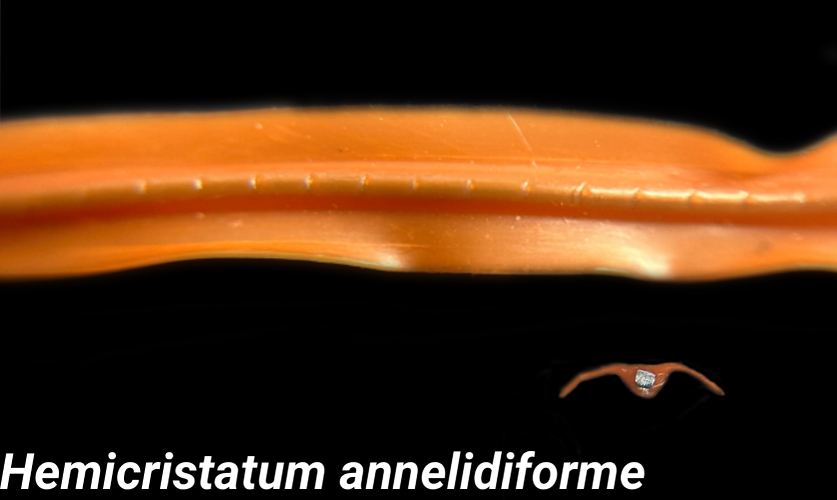
Hemicristatum annelidiforme Lu, 2025
Width 0.35 cm. Ridge superior surface only, with periodical indentations. Margins simple. Wings faintly striated on inferior surface. Surface glabrous.
Ecology/Distribution
Ecology unknown. USA.
Description
Hemicristatum annelidiforme differs from other Hemicristatum but the presence of faint parallel striations on the superior surface and periodical indentations on the superior surface of the central ridge.
The epithet “annelidiforme” refers to the segmented ridge, which echoes the bodies of segmented worms of phylum Annelida.
Type: 6 cm long, brown. Collected and described by Bailey Z. Lu (NESRG) in Northern Virginia, USA.
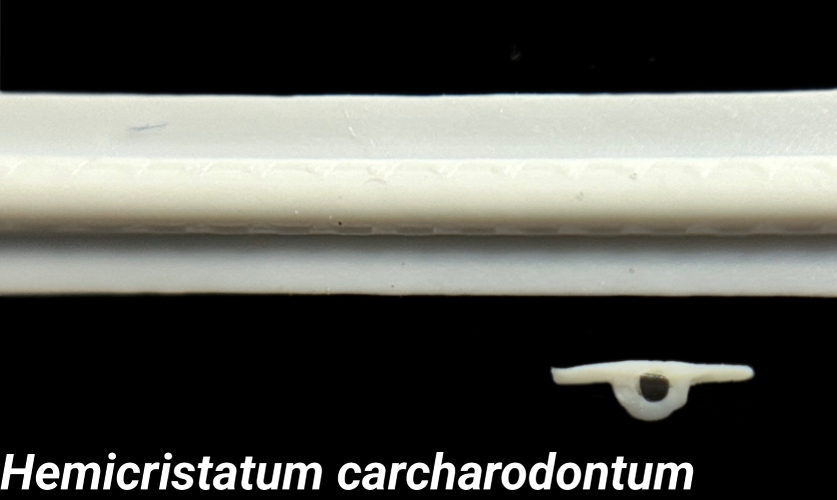
Hemicristatum carcharodontum Lu, 2025
Width 0.3 cm. Ridge superior surface only, framed by raised serrated markings, inferior surface slightly bifurcated. Wings thick. Surface matte.
Ecology/Distribution
Inside face masks. USA.
Description
Another white Hemicristatum? Who could’ve guessed! Although superficially similar to the numerous other white Hemicristatum, H. carcharodontum is the only species with raised triangular markings along the central ridge.
The epithet “carcharodontum” refers to the segmented margins of the ridge, which resemble the maws of a very wide shark.
Type: 9.5 cm long, white. Collected by Bailey Z. Lu (NESRG) from inside a face mask, Northern Virginia, USA.
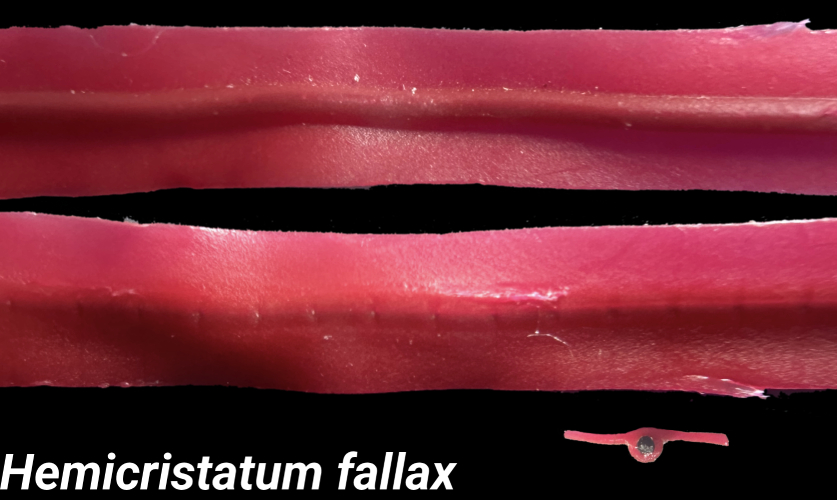
Hemicristatum fallax Lu, 2026
Width 0.35 cm. Ridge superior surface only, inferior surface with faint periodical indentations. Margins simple. Wings not striated on either surface. Surface matte.
Ecology/Distribution
Unknown. Japan.
Description
Hemicristatum fallax closely resembles H. annelidiforme and H. pseudoannelidiforme but differs by its complete lack of striations. H. fallax can also be distinguished from H. annelidiforme by the periodical indentations, which occur on the inferior surface but not the superior surface.
The epithet “fallax” refers to this species’s close resemblance, perhaps “deceitful” resemblance, to other Hemicristatum.
Type: Collected and described by Bailey Z. Lu (NESRG) from a tangle of tunifilids hiding in a drawer, Osaka, Japan.
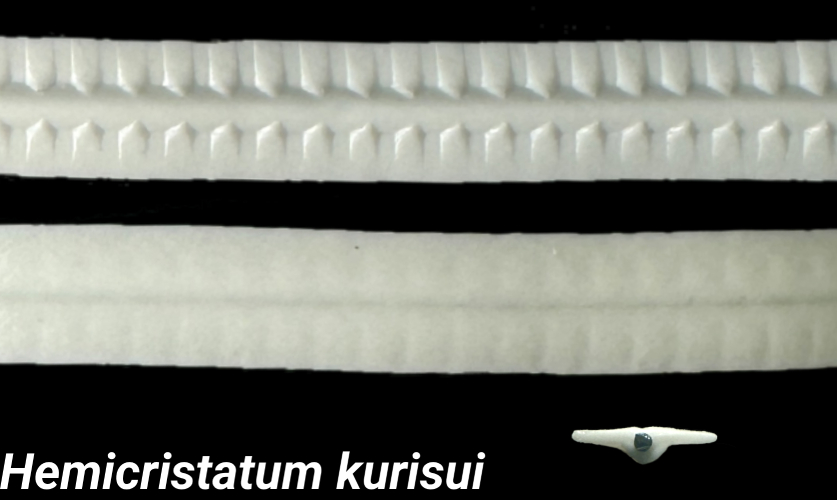
Hemicristatum kurisui Lu, 2026
Width 0.32 cm. Ridge superior surface only. Margins simple. Wings with periodical raised ridges on the superior surface, slightly bifurcated on the inferior surface. Surface matte.
Ecology/Distribution
Ecology unknown. Hong Kong.
Description
Hemicristatum kurisui is characterized by its periodical raised markings, which are distinct from all other species of Hemicristatum. It is reminiscent of Lamifilum metallescens plicatum. However, H. kurisui is described as a species, and not an infrataxon, as its plicated markings are not transitory or variable.
The epithet “kurisui” honors syntherid researcher Kurisu (HELO), who has contributed many tunifilid specimens and support for the NESRG’s projects.
Type: White. Collected by Kurisu (HELO) and described by Bailey Z. Lu (NESRG) from Hong Kong.
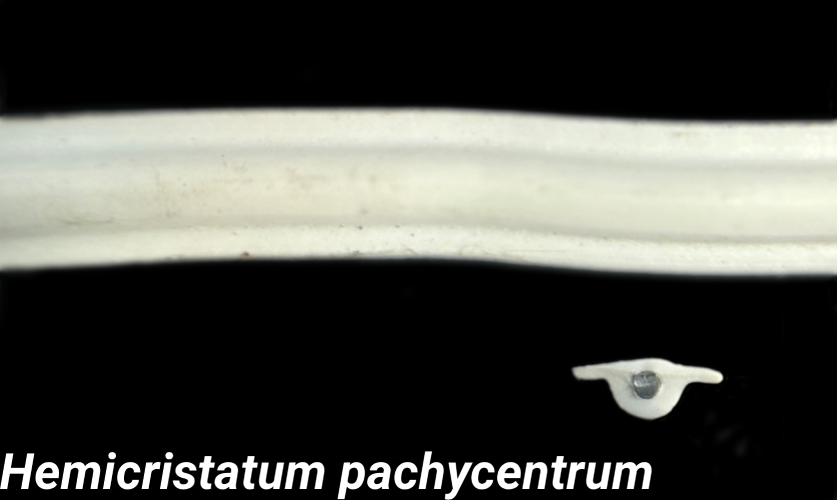
Hemicristatum pachycentrum Lu, 2025
Width 0.25 cm. Ridge superior surface only. Margins simple. Wings thick, reduced. Surface matte.
Ecology/Distribution
Ecology unknown. USA.
Description
Similar to Hemicristatum polyphagum but with a narrower body (0.25cm compared to 0.35 cm) and a slightly wider central ridge (>0.1 cm compared to <0.1 cm).
Type: 14.8 cm long, white. Collected and described by Bailey Z. Lu (NESRG).
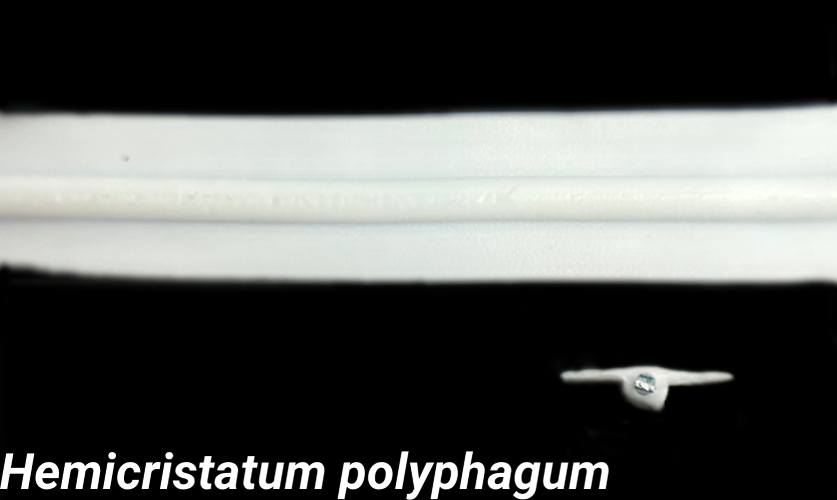
Hemicristatum polyphagum Lu, 2025
Width 0.35 cm. Ridge superior surface only. Margins simple. Wings thick. Surface matte.
Ecology/Distribution
Often found on various products and inside face masks. Cosmopolitan (USA, China, Hong Kong).
Description
Hemicristatum polyphagum is a marking-less species with a wide distribution of hosts and a cosmopolitan distribution. Originally found in the USA but also observed in Hong Kong within face masks, by Kurisu (HELO) and has been found around headphones.
Type: 14 cm long, white, Virginia, USA. Collected and described by Bailey Z. Lu (NESRG).
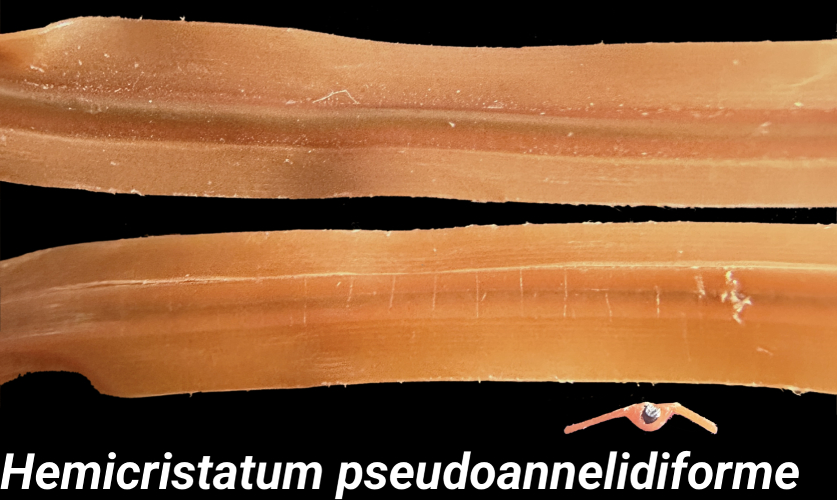
Hemicristatum pseudoannelidiforme Lu, 2026
Width 0.35 cm. Ridge superior surface only, without indentations, inferior surface with faint periodical indentations on a slightly raised central zone. Margins simple. Wings faintly striated on both surfaces. Surface glabrous.
Ecology/Distribution
Unknown. USA.
Description
Hemicristatum pseudoannelidiforme is very similar to H. annelidiforme, differing by the lack of indentations on the ridge itself. In addition to this character, the central portion of the inferior surface (opposite of the ridge) possesses shallow indentations.
The epithet “pseudoannelidiforme” refers to this species’s close resemblance to H. annelidiforme.
Type: Collected and described by Bailey Z. Lu (NESRG) from a bin of a scrap craft store in Atlanta, Georgia, USA.
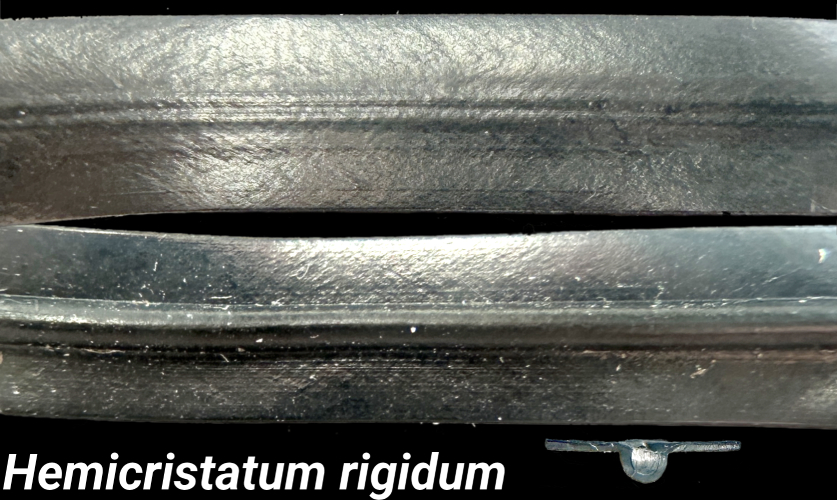
Hemicristatum rigidum Lu, 2026
Width .52 cm. Ridge superior surface only, two faint raised striations on ventral surface. Wings thick, rigid. Surface matte.
Ecology/Distribution
Ecology unknown. USA.
Description
Hemicristatum rigidum is characterized by its large size and two faint raised striations on the ventral (flat) side.
The epithet “rigidum” refers to the rigid quality of the membrane material.
Type: ~30 cm long, black, very rigi. Collected and described by Bailey Z. Lu (NESRG) from a bin of a scrap craft store in Atlanta, Georgia, USA.
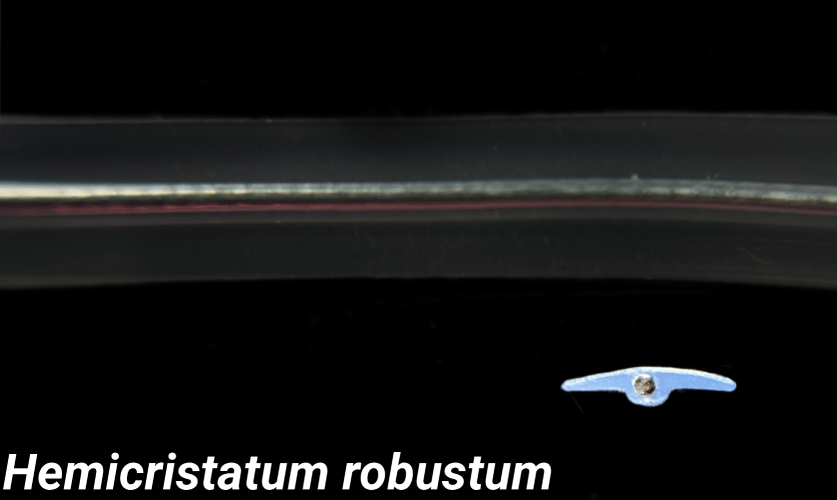
Hemicristatum robustum Lu, 2025
Width 0.4 cm. Ridge superior surface only, sloped outwards from core on inferior surface. Margins simple. Wings thick, rigid. Surface glabrous, hyaline.
Ecology/Distribution
Gift bags. USA.
Description
Very similar to Hemicristatum polyphagum, but much thicker. The wings are so thick that the body is almost recurved, bulging on the inferior surface.
The epithet “robustum” refers to its thick membrane and bulging inferior surface.
Type: 18.1 cm long, nearly transparent. Collected and described by Bailey Z. Lu (NESRG) from around a gift bag, Northern Virginia, USA.

