
Complectocaulids are a class of pseudo-occlupanids of clade Plasticae. They are somewhat similar to order Persolla, but are differentiated by their raised (or partially raised) body, central ridge with two pairs of extensions (which may be merged), and consistent bilateral symmetry. Complectocaulids are also found almost entirely as clamps on items such as aerosol cans or plant stakes.
The family Lepiplastidae has been worked on significantly by independent researcher T. Hiron, based in France, who has uncovered significant species diversity previously not known. We are deeply grateful for their support and contributions to research.
On plant stakes, Complectocaulids often replace “orchid clips” or tunifilids such as Acrista altheina.
Diplocerocaulida: Invertidae
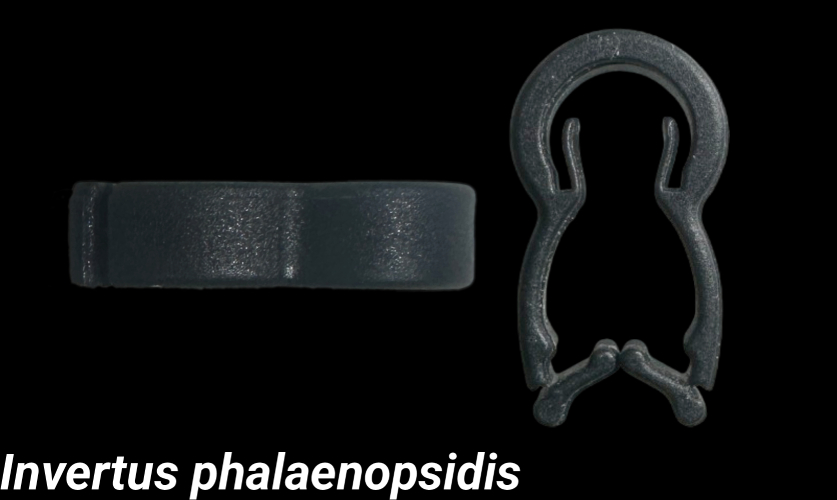
Invertus phalaenopsidis Lu, 2025
Size 1.2×2.0×0.5cm. Horns on interior. Oral Hooks flexible, nearly detached. Surface matte, black.
Ecology/Distribution
Plant stakes (especially Phalaenopsis), USA.
Description
Invertus phalaenopsidis is a very modified and complex Complectocaulid. Like most other members of order Diplocerocaulida, I. phalaenopsidis often occurs in small swarms on a single stake.
The epithet “phalaenopsidis” refers to the host of this species, Phalaenopsis orchids.
Type: Collected by Bailey Z. Lu (NESRG) from an orchid stake, Northern Virginia, USA.
Diplocerocaulida: Lepiplastidae
Lepiplastidae is a family of plastic clips separated from Invertidae by their horns on the outside of the main body. It contains one genus (Lepiplastida). They are almost entirely found on plants and plant stakes. Species are often variable in size, and thus we do not rely on the physical dimensions of a specimen as a character, and we do not describe any infrataxa based on differences in simply size.
The type species of Lepiplastida is L. lata Lu, 2025.
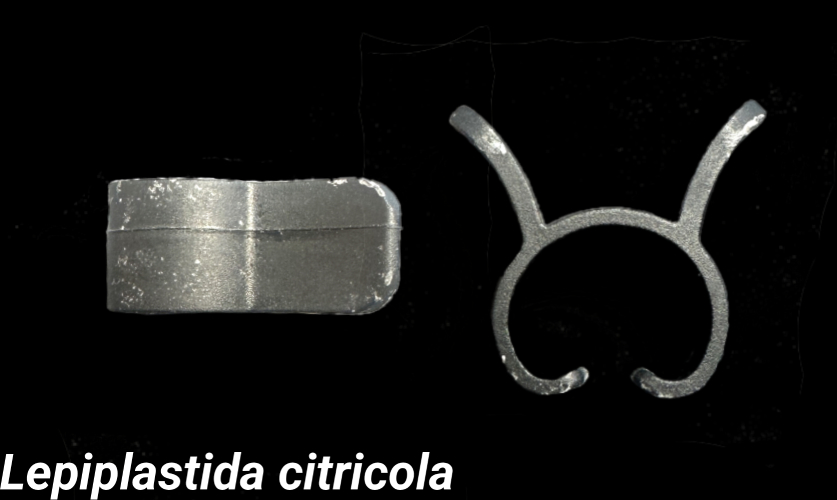
Lepiplastida citricola Lu, 2026
Size 2.8×2.9×0.8cm. Horns on exterior, recurved, not thickened. Oral Hooks obtusely angled inwards. Surface matte, black.
Ecology/Distribution
Potted Citrus stakes, USA.
Description
Lepiplastida citricola is characterized by its simple horns without thickened segments and simple oral hooks that are not thickened and obtusely (gradually) angled inwards. This species has been found only on potted Citrus plants thus far, sometimes being deformed due to thick host trunks. It is not uncommon to find several individuals on one host.
The epithet “citricola” refers to the host of this species: various cultivated Citrus plants.
Type: Collected by Bailey Z. Lu (NESRG) from a Citrus stake in a Home Depot, Northern Virginia, USA.
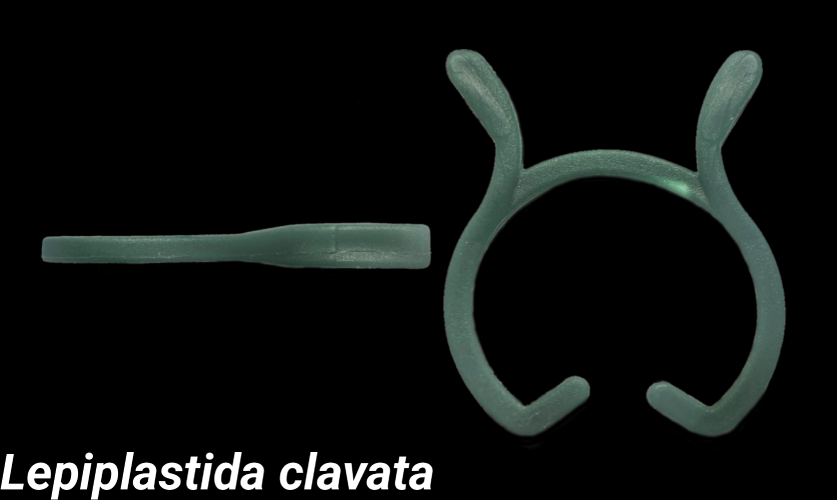
Lepiplastida clavata Hiron, 2026
Size 3.8×3.2×0.2(0.4)cm. Horns short, widened significantly, clavate, on exterior, barely thickening vertically over the main body without clear delineation. Horn Bases completely overlapping the main body. Oral Hooks acutely obtusely inwards, rounded at ends.
Ecology/Distribution
Garden centers, France.
Description
Lepiplastida clavata is a member of the L. lata complex but is easily distinguished by the clavate, expanded horns and less strongly incurved oral hooks.
The epithet “clavata” refers to the enlarged horns.
Type: Collected and described by researcher T. Hiron from a florist shop, France.
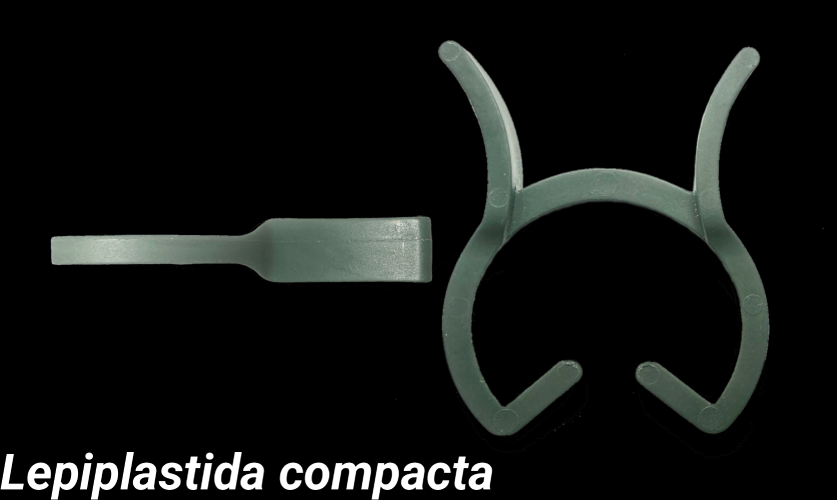
Lepiplastida compacta Hiron, 2026
Size 3.25×2.7×0.2(0.6)cm. Horns on exterior, thickening vertically abruptly over the main body with clear delineation. Horn Bases completely overlapping the main body. Oral Hooks acutely angled inwards, rounded at ends.
Ecology/Distribution
Garden centers, France.
Description
A member of the Lepiplastida lata complex, L. compacta is differentiated by horns that extend fully into the main body and horns that are raised abruptly at the base. It is closely allied to L. elongata, but L. elongata has horns that are raised very gradually.
The epithet “compacta” refers to the abrupt angle that the horn base fuses to the main body.
Type: Collected and described by researcher T. Hiron from a florist shop, France.
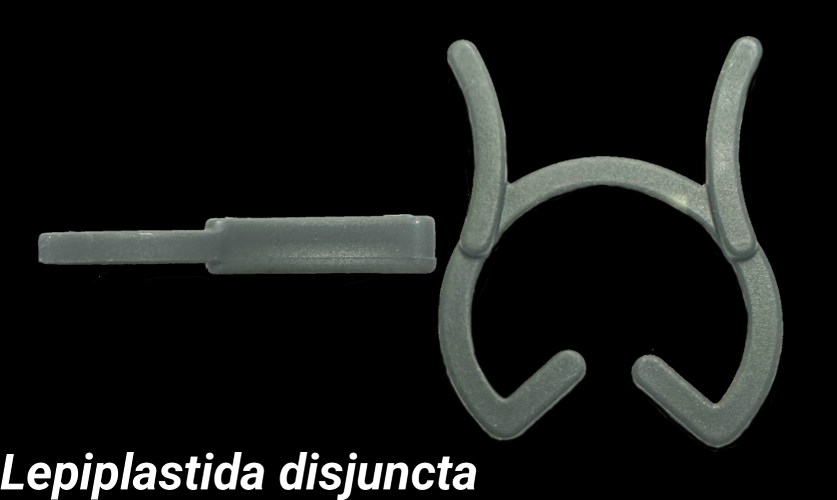
Lepiplastida disjuncta Hiron, 2026
Size 2.15×2.1×0.2(0.45)cm. Horns on exterior, thickened vertically but not fused with main body. Horn Bases completely overlapping the main body, terminating suddenly. Oral Hooks subacutely angled inwards, rounded at ends.
Ecology/Distribution
Garden centers, France.
Description
Part of the Lepiplastida lata complex, L. disjuncta is unique in having horn bases that do not taper or fuse into the main body at all. In addition to this, the horns extend fully into the main body and the oral hooks are very angular, held at an acute angle.
The epithet “disjuncta” refers to the distinct horn and main body, which remain separated.
Type: Collected and described by researcher T. Hiron from a florist shop, France.
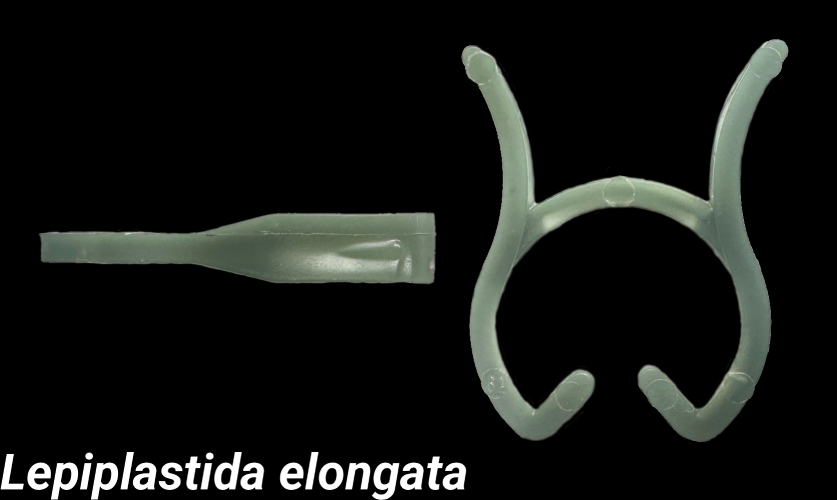
Lepiplastida elongata Hiron, 2026
Size 2.65×2.05×0.2(0.45)cm. Horns on exterior, thickening vertically gradually over the main body with clear delineation. Horn Bases completely overlapping the main body. Oral Hooks acutely angled inwards, rounded at ends.
Ecology/Distribution
Garden centers France.
Description
Lepiplastida elongata is closely allied to L. compacta within the L. lata complex. It is distinguished from L. compacta by its gradually raised horns. It is separated from other species in the complex by horns that extend fully into the main body.
The epithet “elongata” refers to the gradual and elongated manner that the horn base fuses to the main body.
Type: Collected and described by researcher T. Hiron from a florist shop, France.
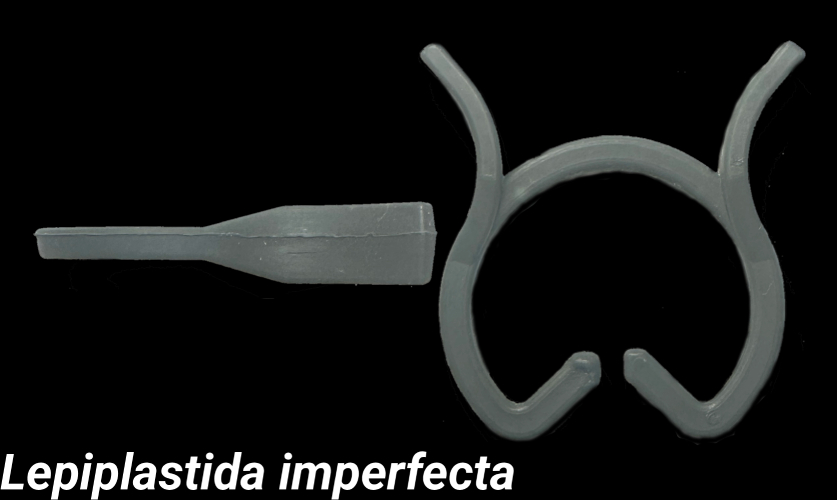
Lepiplastida imperfecta Hiron, 2026
Size 3×2.85×0.2(0.6)cm. Horns on exterior, thickening vertically gradually over the main body with clear delineation. Horn Bases completely overlapping the main body. Oral Hooks subobtusely angled inwards, truncate at ends.
Ecology/Distribution
Garden centers, France.
Description
Lepiplastida imperfecta is a rather mysterious member of the L. lata complex, distinguishable by almost truncate/rectangular tips of the horns and acute oral hooks. The horns nearly extend fully into the main body. Considering the imperfect, possibly defective state of the type specimen, this is a rather odd member of the complex.
The epithet “imperfecta” refers to the various imperfections observed on specimens and the angled, un-rounded features.
Type: Collected and described by researcher T. Hiron from a florist shop, France.
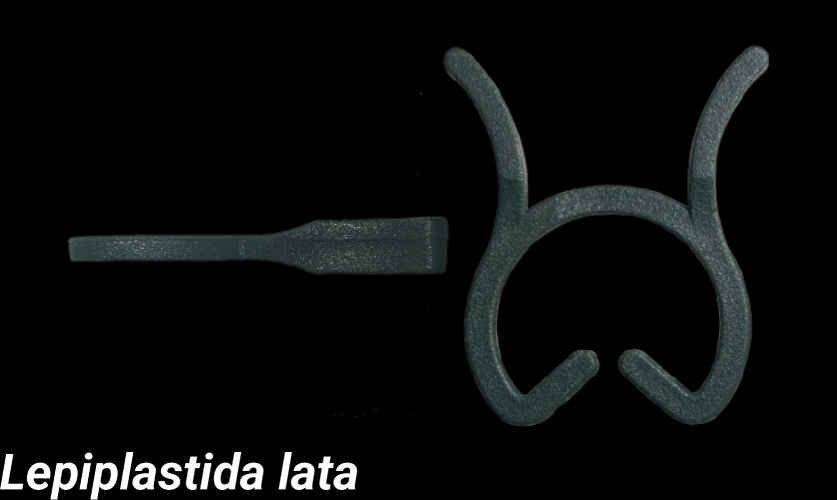
Lepiplastida lata Lu, 2025
Size 2.2×2.6×0.15(.3)cm. Horns on exterior, thickening vertically smoothly outside the main body with clear delineation only at the thicker end. Horn Bases overlapping the main body about halfway. Oral Hooks acutely angled inwards, rounded at ends.
Ecology/Distribution
Various houseplant stakes, USA.
Description
Lepiplastida lata possesses thickened horns which are significantly thicker compared to the rest of the body. Although L. lata can occur in small swarms (2-3) on a single stake, it is not uncommon to find them solitary.
The epithet “lata” refers to the wide oral groove of this species.
Type: Collected by Bailey Z. Lu (NESRG) from a houseplant stake in a Home Depot, Northern Virginia, USA.
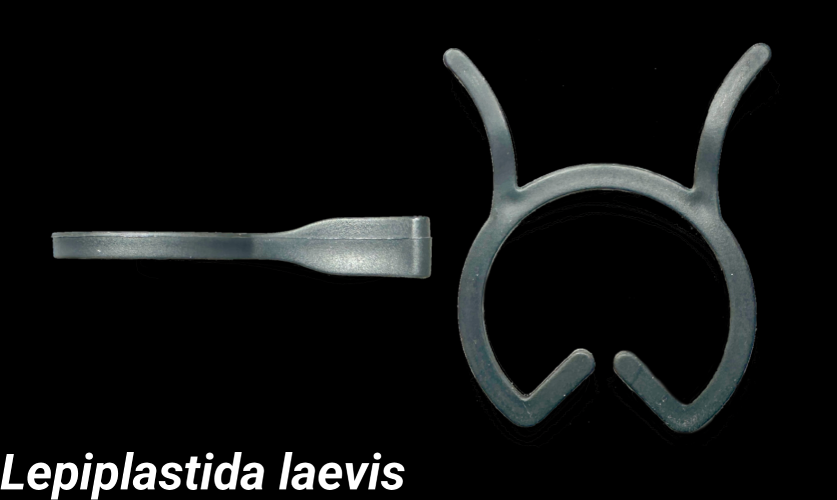
Lepiplastida laevis Hiron, 2026
Size 3.25×3.75×0.2(0.5)cm. Horns on exterior, thickening vertically smoothly outside the main body without clear delineation. Horn Bases not overlapping the main body. Oral Hooks acutely angled inwards, rounded at ends.
Ecology/Distribution
Garden centers, France.
Description
A member of the Lepiplastida lata complex, L. laevis is similar to many other species. It is readily distinguished from the closest species (e.g. L. lata) by the horn bases fusing directly to the main body, creating a flat, smooth, sometimes slightly depressed base. The horns of L. lata and L. imperfecta extend slightly into the body, leaving a raised ledge. Those of L. compacta, L. clavata, and L. elongata extend fully into the width body, only fusing past the base of the horns, further towards the oral hooks.
The epithet “laevis” refers to the smooth transition of the horn base to the main body.
Type: Collected and described by researcher T. Hiron from a florist shop, France.
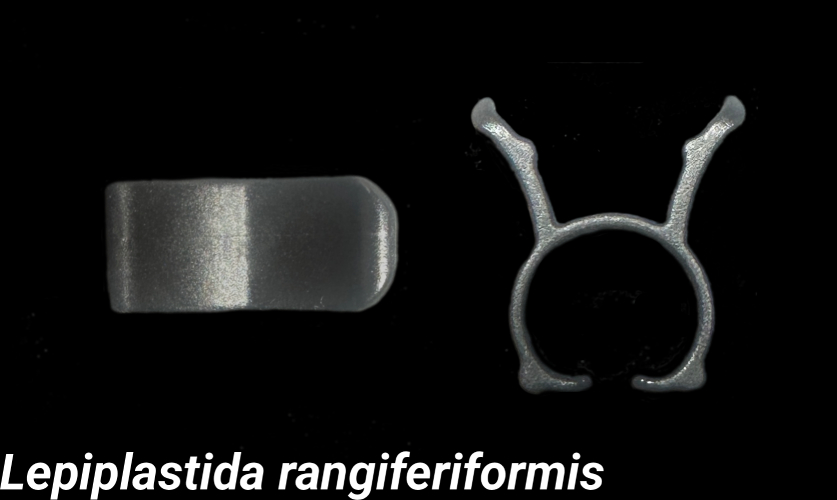
Lepiplastida rangiferiformis Lu, 2025
Size 2.6×1.75×0.7cm. Horns on exterior, with nodule along the inner surface. Oral Hooks slightly angled inwards, widened at base. Surface matte, black.
Ecology/Distribution
Plant stakes (especially Phalaenopsis), USA.
Description
Lepiplastida rangeriformis posseses widened bumps along its body. It often occurs in small swarms on a single stake, most commonly found on stakes associated with Phalaenopsis orchids. L. r. minima has been synonymized with the species to account for variation within the species. It occurs in the same niches as L. r. rangeriformis.
The epithet “rangeriformis” refers to the resembles the horns have to reindeer (Rangifer) antlers.
Type: Collected by Bailey Z. Lu (NESRG) from an orchid stake, Northern Virginia, USA.
= Lepiplastida rangiferiformis minima Lu, 2026
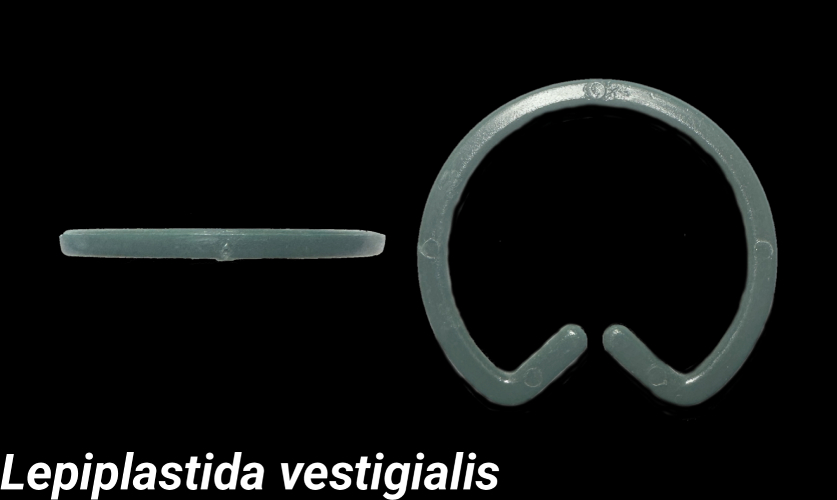
Lepiplastida vestigialis Hiron, 2026
Size 2.8×3×0.2cm. Horns absent. Oral Hooks obtusely angled inwards, rounded at ends.
Ecology/Distribution
Garden centers, France.
Description
Lepiplastida vestigialis is an anomalous member of the Complectocaulia, placed here primarily based on its rough morphology (e.g. bilateral symmetry, oral hook shape) and molecular data. This species is heavily reduced, with vestigial horns that are not visible. It resembles many members of the L. lata complex but lacks horns, representing the oldest diverging member of the group.
The epithet “vestigialis” refers to the reduced morphology of this species.
Type: Collected and described by researcher T. Hiron from a florist shop, France.
Syncerocaulida: Simplicodenidae
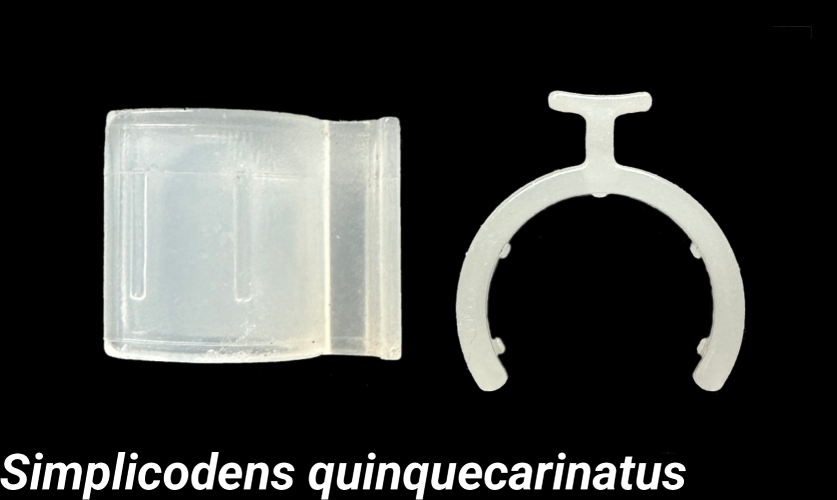
Simplicodens quinquecarinatus Lu, 2026
Size 1.7×1.5×1.4cm. Horns on exterior, fused. Oral Hooks essentially absent, with five small ridges on the interior. Surface glabrous, hyaline.
Ecology/Distribution
Unknown, USA. Likely to be found on aerosol cans?
Description
Simplicodens quinquecarinatus is the first species of order Syncerocaulida to be described. Its horns are fused at the base, and it lacks defined hooks. Instead, five small ridges line the oral groove.
The epithet “quinquecarinatus” refers to the five small ridges in its oral groove.
Type: Collected by Bailey Z. Lu (NESRG) from Northern Virginia, USA.

