
Family Geminipapyridae is characterized by both surfaces of the body being composed of paper.
Margicora
Margicora is characterized by two central cores at the edges of the body, with wings absent. Instead, a central membrane is formed between the two cores.
Type species: Margicora planicristata Lu, 2025
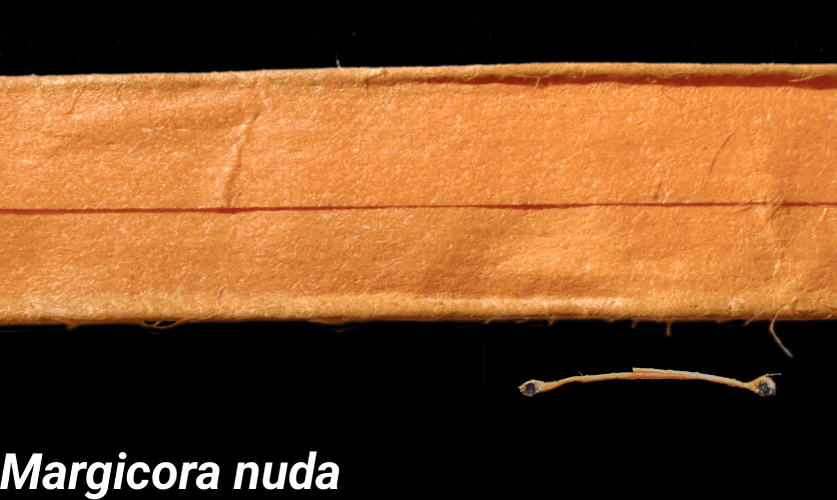
Margicora nuda Lu, 2026
Width 0.7 cm. Ridges both surfaces, separated, not flattened or thickly coated. Central membrane thin, weak, with a seam (from an overlapping membrane). Wings absent. Surface smooth, raw paper.
Ecology/Distribution
Ecology unknown. Japan.
Description
Margicora nuda differs from all other Margicora by its very thin membrane and ridges that are not thickened or flattened at all. This species is also notable for the presence of a seam (as seen in the photo) where the membrane overlaps with itself.
The epithet “nuda” refers to the almost naked quality of the ridges compared to other members of Margicora.
Type: Orange, with repeated patterning on one side reading “BECAUSE I WANT TO SEE YOUR FACE WITH A SMILE”. Collected and described by Bailey Z. Lu (NESRG) from a tangle of tunifilids hiding in a drawer, Osaka, Japan.
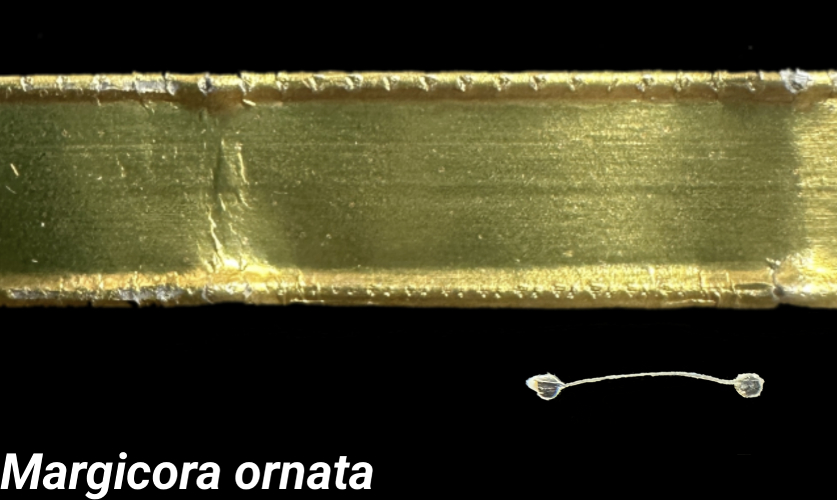
Margicora ornata Lu, 2026
Width 0.77 cm. Ridges both surfaces, at margins, with periodical indentations. Wings absent. Central membrane robust, inflexible, with a seam (from an overlapping membrane). Surface glabrous, metallic.
Ecology/Distribution
Bags of food. Europe (Austria, France).
Description
Margicora ornata is characterized by its inflexible and glabrous membrane with a seam present on one surface. As of the publication of this species (July 4th, 2026), this species has only been found in Europe. Specimens with silver coloration have been observed by field researcher T. Hiron.
The epithet “ornata” refers to the metallic coloration of this species, and its decorated ridges.
Type: Collected by an anonymous researcher and described by Bailey Z. Lu (NESRG) from a bag of “Mozart’s Balls” chocolate in Salzburg, Austria.
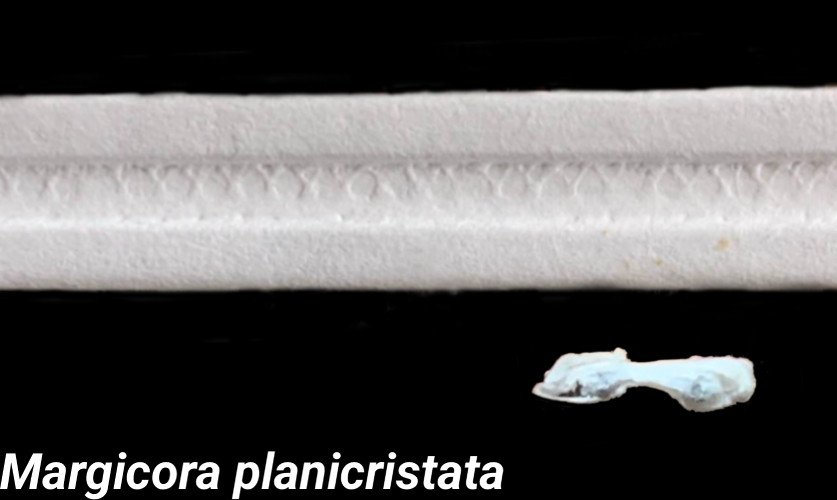
Margicora planicristata Lu, 2025
Width 0.95 cm. Ridges both surfaces, separated, flattened to ~1/3 total width. Central membrane with raised decussate striations. Wings absent. Surface rough, raw paper.
Ecology/Distribution
Ecology unknown. USA.
Description
Distinctive from other members of Margicora for its wide and flattened ridges.
Type: White. Specimen collected by an anonymous researcher and described by Bailey Z. Lu (NESRG) from Illinois, USA.
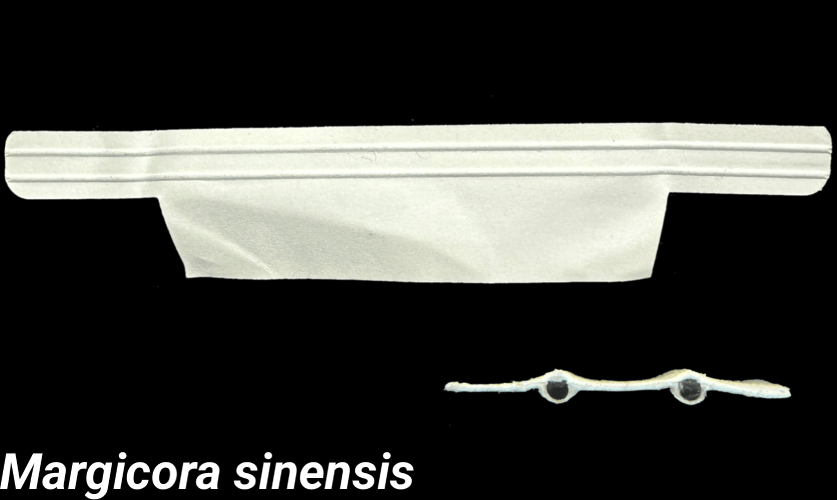
Margicora sinensis Kurisu, 2026
Width 0.85 cm, 1.80 cm at thickest. Ridges both surfaces, more pronounced on one surface. Margins simple. Wings with a symmetrical trapezoidal extension on one side, edges of main body with obtuse, rounded corners. Surface rough, raw paper.
Ecology/Distribution
Attached to flat food-containing bags. Asia (Hong Kong, China).
Description
Margicora sinensis differs from other Margicora by its symmetrical extension and habitat. M. sinensis binds itself to hosts, flat bags, using the extension. The bound specimen can then seal bags by folding over the opening and using the narrow ends of the body to clamp the bag in place. This species has been observed in Hong Kong by Kurisu (HELO) and China by Bailey Z. Lu (NESRG). In China, morphs containing brown and white pigment were both observed, as well as individuals of varying lengths.
The epithet “sinensis” refers to the known range of this species.
Type: Collected and described by Kurisu (HELO) from a bag containing bread, Hong Kong.
Pseudodipapyra Chipz, 2025
Pseudodipapyra is characterized by two adjacent central cores, often closely resembling Dipapyra.
Type species: Pseudodipapyra pittaciphila Chipz, 2025
Pseudodipapyra pittaciphila Chipz, 2025
Width 0.6 cm. Ridges both surfaces, clustered. Wings simple. Surface rough, raw paper.
Ecology/Distribution
Plant tags. Canada.
Description
Type: White. Collected and described by independent researcher Cale Chipz from Elburg Smit printed plant tags for Coleus scutellarioides Volcanicola ‘French Quarter’, Canada.

