
Family Dipapyridae is characterized by both surfaces of the body being composed of paper or paper-like material. All species of Dipapyridae possess a ridge on both surfaces.
Dipapyra is the only genus in this family.
Dipapyra Lu, 2025
Dipapyra are characterized by a body composed of paper with ridges present on both surfaces.
Type species: Dipapyra vulgaris Lu, 2025
Restructuring Dipapyra: An Assessment of Variability (Jan. 28, 2026)
As more and more specimens of Dipapyra have been collected and identified, there is an increasing number of known populations with varying widths. For example, specimens have been found with widths 0.3cm, 0.4cm, 0.5cm, and so on. This wide range of variation in width without variation in other characters has led to the lumping of Dipapyra iuxta and Dipapyra inaequalis into Dipapyra vulgaris, with both being demoted to being a subspecies of Dipapyra vulgaris. Dipapyra eucalypticola was demoted to being subspecies of Dipapyra variabilis.
The purpose of this restructuring is to account for the fact that Dipapyra species seem to have great variability in width. Dipapyra vulgaris is distinguished from Dipapyra eucalypticola based on its membrane texture: D. vulgaris has a rough surface, whereas D. eucalypticola has a polished and smooth/glabrous surface. This new taxonomy also increases the accessibility of identification of Dipapyra in the field, since scale is no longer required to identify any specimen to species level.
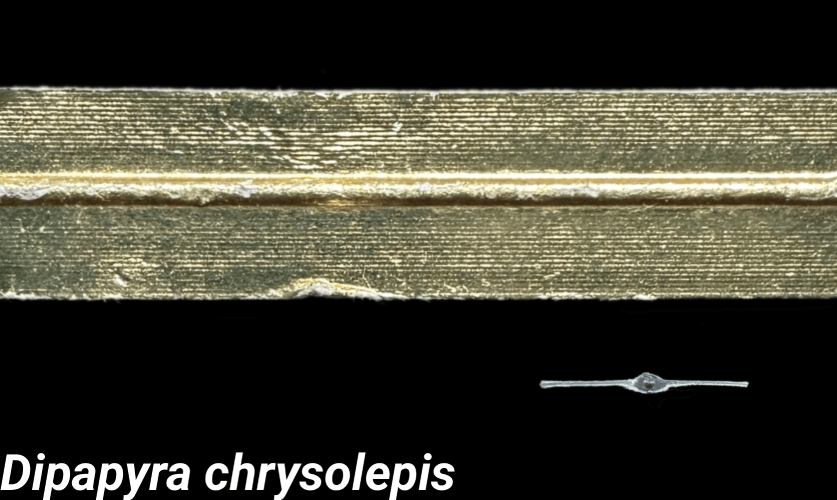
Dipapyra chrysolepis Lu 2026
Width 0.61 cm. Ridge both surfaces. Wings lightly striated, thick. Surface metallic, often flaking.
Ecology/Distribution
Bread products. USA.
Description
Dipapyra chrysolepis is distinguished from Dipapyra variabilis by its striated wings. It is also often found at shorter lengths than D. variabilis.
The epithet “chrysolepis” refers to the golden color and flaky qualities of the membrane.
Type: 12 cm long, golden. Collected by Bailey Z. Lu (NESRG) from bread at a Wegmans supermarket, Northern Virginia, USA.
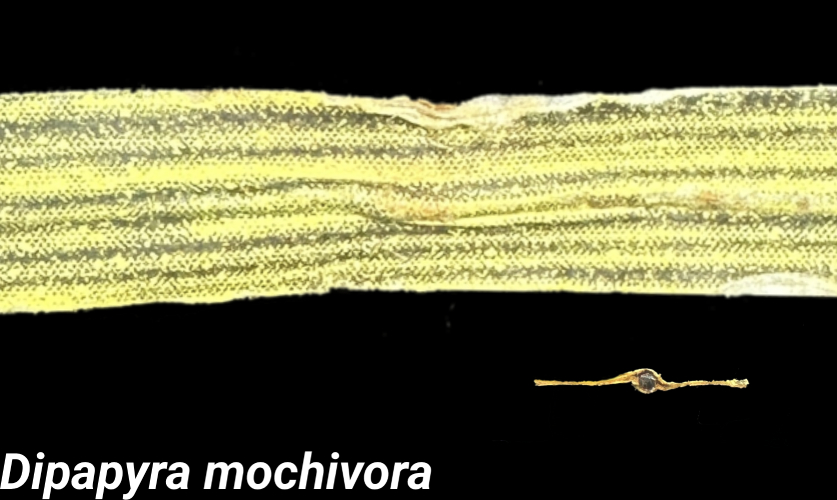
Dipapyra mochivora Lu, 2026
Width 0.60 cm. Ridge both surfaces. Margins simple. Wings weak, inflated. Surface rough, raw paper.
Ecology/Distribution
Grass-themed mochi packaging. Japan.
Description
Dipapyra mochivora is characterized by its weak, inflated membrane. This tunifilid differs from all other Dipapyra by this character. This species is currently known only from wrapping the packaging of mochi products, which is themed after grass.
The epithet “mochivora” refers to this species’s ecology.
Type: Yellow with brown variegated stripes. Collected by Aulax ‘Pataplenist Slembibreytursson (NESRG) and described by Bailey Z. Lu (NESRG) from a tangle of tunifilids hiding in a drawer, Osaka, Japan.
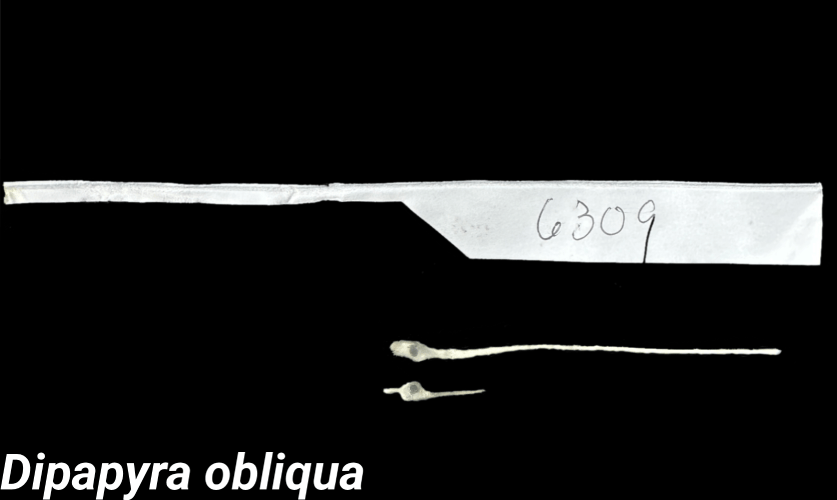
Dipapyra obliqua Lu, 2026
Width 0.4 cm, 1.6 cm at the thickest. Ridge both surfaces. Margins simple. Wings with trapezoidal extension on one side. Surface rough, raw paper.
Ecology/Distribution
Unknown. USA.
Description
Dipapyria obliqua is characterized by a trapezoidal extension of the wing on one side of the body. It is distinctive in shape from all other species of Dipapyra.
The epithet “obliqua” refers to the oblique edge of the extended wing.
Type: 15.1 cm long, white. Collected by Bailey Z. Lu (NESRG) from a bin at a scrap craft store in Atlanta, Georgia, USA.

Dipapyra variabilis Lu, 2025
Width 0.95 cm. Ridge both surfaces. Margins simple. Wings simple. Surface smooth, glabrous, polished.
Ecology/Distribution
Various vegetables. USA.
Description
Dipapyra variabilis is distinguished from Dipapyra vulgaris by the surface quality of the membrane: D. variabilis has a smooth/glabrous surface, whereas D. vulgaris has a rough, papery surface.
The epithet “variabilis” refers to the great variability in colors in markings– individuals with yellow, black, white, and green markings have been found.
Type: 50.8 cm long, blue with white variegation. Collected by Bailey Z. Lu (NESRG) from celery in a Whole Foods market, Northern Virginia, USA.
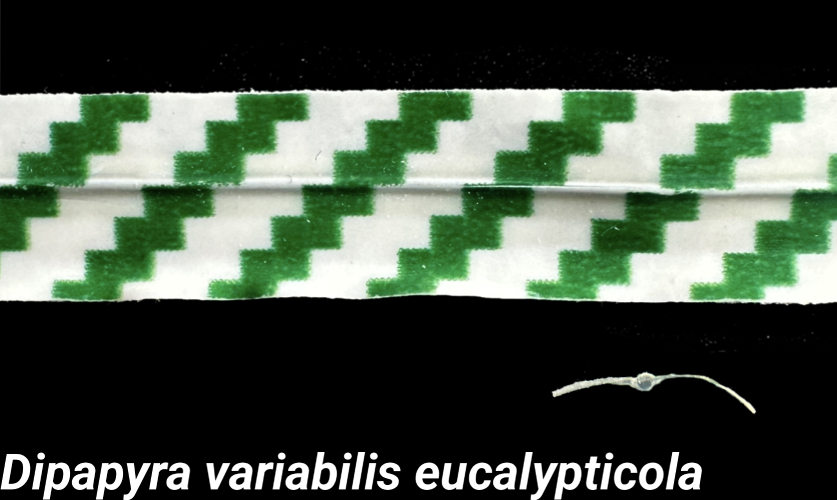
Dipapyra variabilis eucalypticola (Chipz, 2025)
Width 0.61 cm. Wings thin.
Ecology/Distribution
Bundles of vegetation. North America (USA, Canada).
Description
A highly variable subspecies of Dipapyra variabilis, D. variabilis eucalypticola is found in many colors. It is distinguished from other D. variabilis by its width and thin wings.
The infraspecific epithet “eucalypticola” refers to the substrate the type specimens were collected from.
Syntypes: 25.4cm long, colors varying (red, yellow, blue, checkered with white and green). Collected by Cale Chipz from bundles of Eucalyptus, in Canada.
= Dipapyra eucalypticola Chipz, 2025
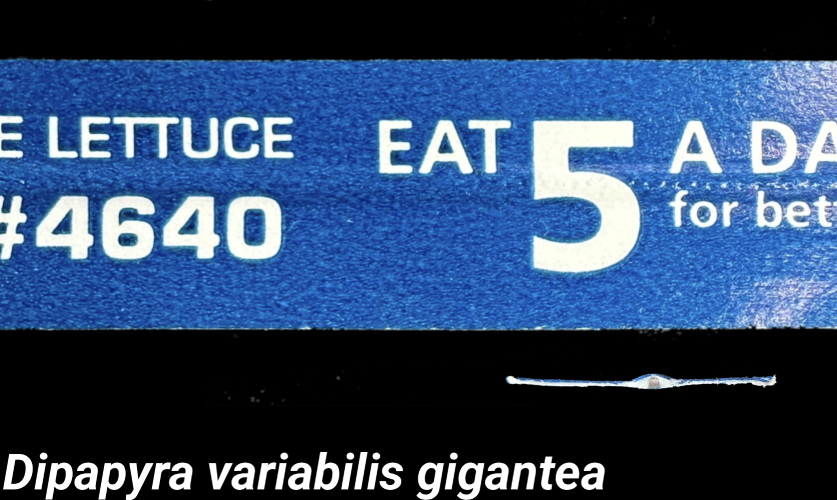
Dipapyra variabilis gigantea Lu 2026
Width 1.1 cm. Wings thick.
Ecology/Distribution
Bundles of vegetation, Americas.
Various vegetables, grocery stores. USA.
Description
The infraspecific epithet “gigantea” refers to the large size of this subspecies.
Rather common, especially on herbs such as cilantro or parsley. Distinguished from other subspecies of Dipapyra variabilis by its large size.
The infraspecific epithet “gigantea” refers to its large size.
Type: Around 45 cm long, blue with white markings. Collected by Bailey Z. Lu (NESRG) from a head of lettuce in a Safeway grocery store, Northern Virginia, USA.
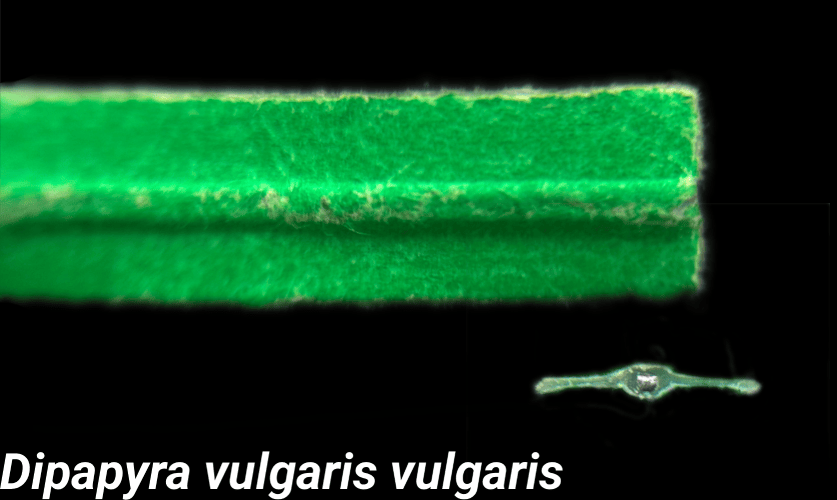
Dipapyra vulgaris Lu, 2025
Width 0.4 cm. Margins simple. Wings thick. Surface rough, raw paper.
Ecology/Distribution
Cosmopolitan, often in grocery stores.
Description
Dipapyra vulgaris is characterized by the rough papery texture of its membrane.
Dipapyra vulgaris vulgaris may be one of the most commonly found tunifillid, with one specific strain often being found in specific nesting sites within grocery stores. These sites are often disturbed or moved by humans, and are often called “Twist-ease”. Specimens from these nesting sites are usually around 10 cm long and green.
They most often come in green and white, although red, blue, black, tan, and pink strains are known to exist. Some may even possess variegated patterns.
The epithet “vulgaris” refers to it being commonly found.
Type: 9.8 cm long, green. Collected by Bailey Z. Lu (NESRG) from a “Twist-ease” nesting sites in a Safeway grocery store, Northern Virginia, USA.

Dipapyra vulgaris inaequalis (Lu, 2025)
Morphology
Width 0.79 cm. Wings thin.
Ecology/Distribution
Grain aisles. USA.
Description
Dipapyra vulgaris inaequalis is characterized by its width, often off-center placement of the core, and thin wings.
The epithet “inaequalis” refers to the placement of the core.
Type: 15.24 cm long, white with blue markings. Collected by Bailey Z. Lu from an open container in a Whole Foods market grain aisle, Northern Virginia, USA.
= Dipapyra inaequalis Lu, 2025
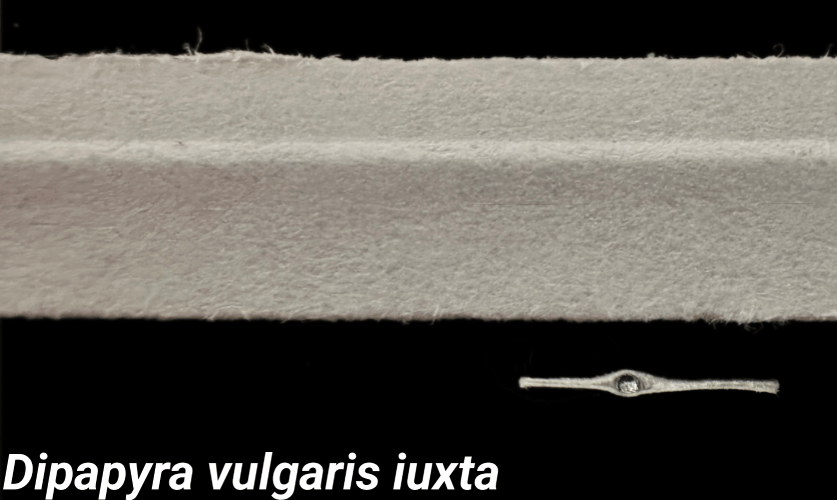
Dipapyra vulgaris iuxta (Lu, 2025)
Width 0.48 cm.
Ecology/Distribution
Baked goods. USA.
Description
Dipapyra vulgaris iuxta is characterized by its width.
The epithet “iuxta” refers to its similarity to Dipapyra vulgaris vulgaris.
Type: 10.1cm long, white. Collected by Bailey Z. Lu (NESRG) from bags of bread in a Whole Foods market, Northern Virginia, USA.
= Dipapyra iuxta Lu, 2025
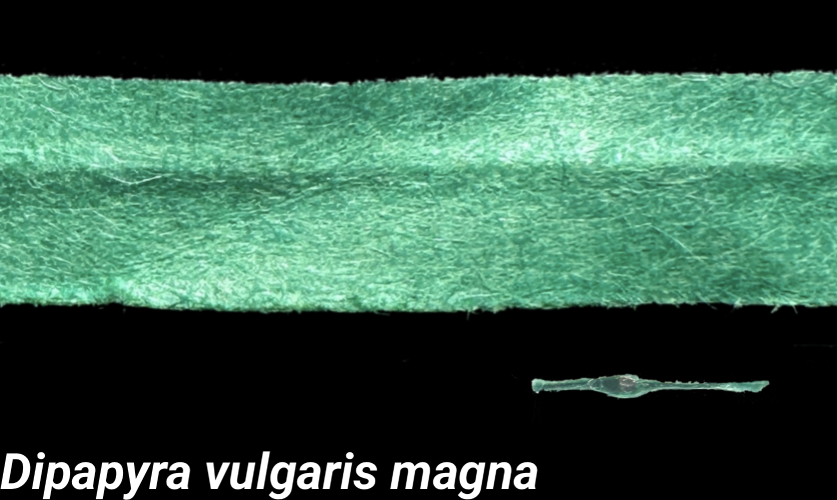
Dipapyra vulgaris magna Bees, 2026
Width 0.55 cm.
Ecology/Distribution
Unknown. USA.
Description
Dipapyra vulgaris magna is characterized by its width. It is slightly larger than D. vulgaris iuxta, and has only been found in the dark green color.
The epithet “magna” refers to its relatively large size.
Type: Dark blue-green. Collected by independent researcher Bees from Pennsylvania, USA.
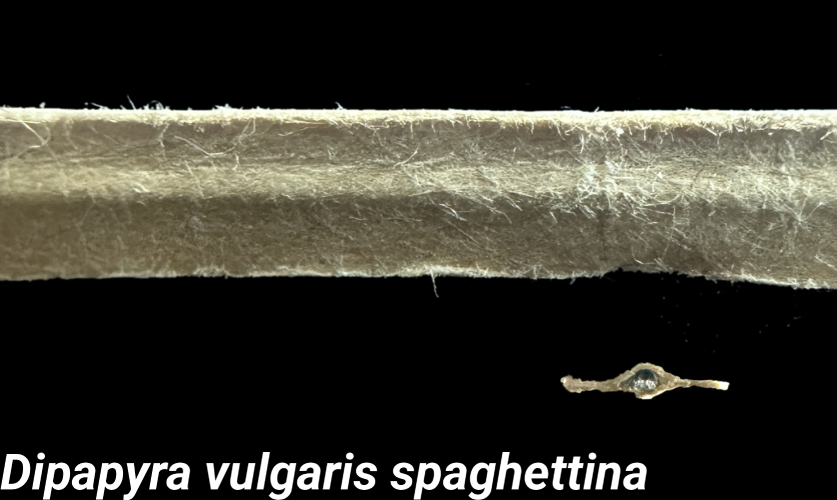
Dipapyra vulgaris sphagettina Slembibreytursson, 2026
Width 0.3 cm.
Ecology/Distribution
Unknown. USA.
Description
Dipapyra vulgaris sphagettina is characterized by its width.
Slembibreytursson was about to pour a jar of marinara sauce onto what he thought was pasta when he realized it was instead a long tunifilid.
The infraspecific epithet “sphagettina” refers to this encounter and the tunifillid’s resemblance to certain pastas.
Type: 34.8 cm long, tan. Collected by Aulax ‘Pataplenist Slembibreytursson (NESRG) from Pennslyvania, USA.
Amplicordis Lu, 2026
Amplicordis is distinct from Dipapyra by its expanded, flat core. This monotypic genus is currently the only known tunifilid with a non-circular core.
Type species: Amplicordis conduplicatus Lu, 2026
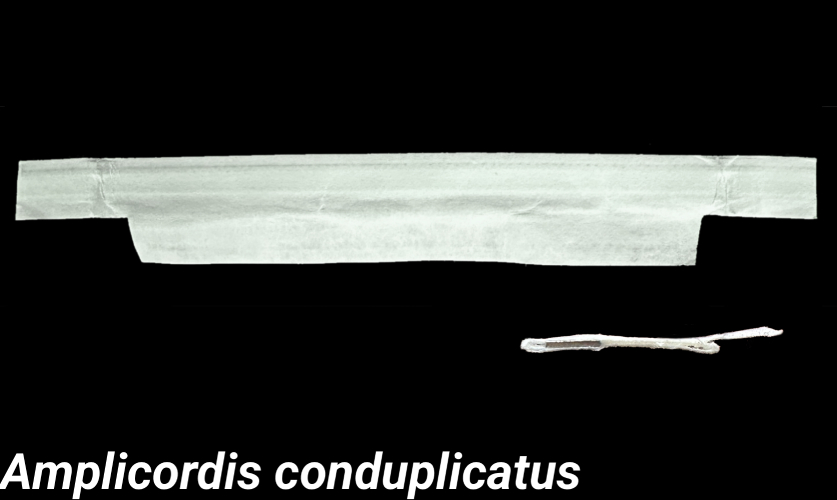
Amplicordis conduplicatus Lu, 2026
Width 1.20(2.20) cm. Ridge one surface. Margins simple. Wings with a symmetrical trapezoidal extension on one side, edges of main body right-angled, unrounded corners. Surface rough, raw paper.
Ecology/Distribution
Cookie Bags, USA.
Description
Amplicordis conduplicatus is characterized by its thick, rough membrane and trapezoidal extended wing.
The epithet “conduplicatus” refers to the folded membrane of this species– it is folded over onto itself along the main body.
Type: White. Collected and described by Bailey Z. Lu (NESRG) from a bag of Tate’s Bake Shop cookies, Northern Virginia, USA.

