
Crassifilum Lu, 2025
Crassifilum are characterized by thick and/or pliable wings with the central ridge present on both surfaces.
Please note that some species, namely C. cuscutaeformis, represent cryptic species complexes that have yet to be resolved! There are many undescribed species belonging to this complex.
Type species: Crassifilum striatulus Lu, 2025
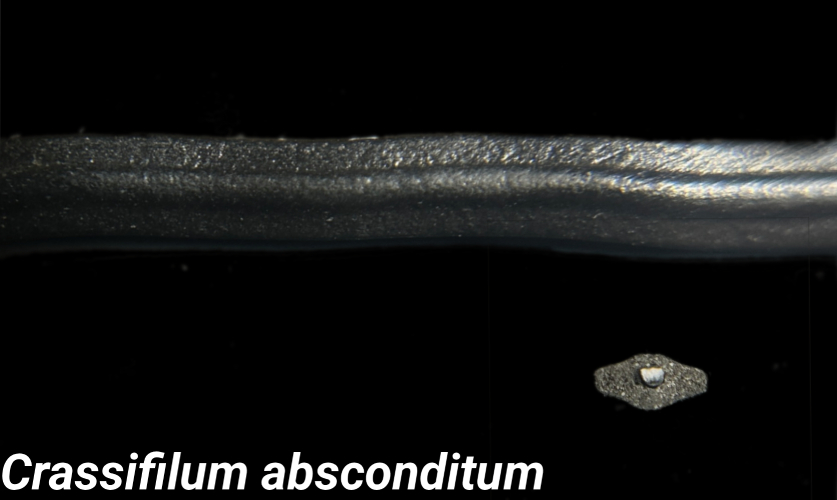
Crassifilum absconditum Lu, 2025
Width 0.2 cm. Ridge both surfaces, not well defined. Margins simple. Wings heavily thickened, fleshy, reduced. Surface textured.
Ecology/Distribution
Around electrical appliance cords. USA.
Description
Crassifilum absconditum is an odd outlier in the genus Crassifilum, as it has a membrane composed of material similar to that found in Acrista altheina. C. absconditum is also distinctive from other species by its faint, poorly defined central ridge. In many cases, this ridge may be undetectable unless the tunifilid is held up to a light or if a cross section is taken. Very similar to Crassifilum nanopinicolum but with a less-defined central ridge and wider, fleshier wings.
The epithet “absconditum” refers to the obscured central ridge.
Type: 10.8cm long, black. Collected and described by Bailey Z. Lu (NESRG) from the cords of a “dash cam” for vehicles, Northern Virginia, USA.
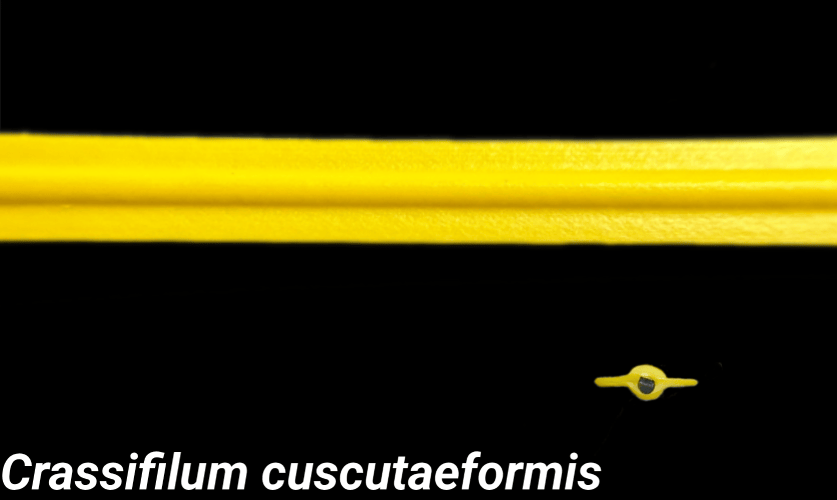
Crassifilum cuscutaeformis Lu, 2025
Width 0.2 cm. Ridge both surfaces, well defined. Margins simple. Wings thick, lightly striated. Surface smooth.
Ecology/Distribution
Around or on various plants. USA, China.
Description
Crassifilum cuscutaeformis is a common tunifillid in garden centers and supply stores, often found sold as a product or found preying on plants. C. cuscutaeformis differs from C. nanopinicolum by a smaller central ridge and thinner wings.
The epithet “cuscutaeformis” refers to the plant genus Cuscuta, a group of parasitic vines, which this species resembles both in appearance and ecology. Morphs in green and black have been observed.
Type: 29.5 cm long, yellow. Collected by Bailey Z. Lu (NESRG) from around a Clematis, Northern Virginia, USA.
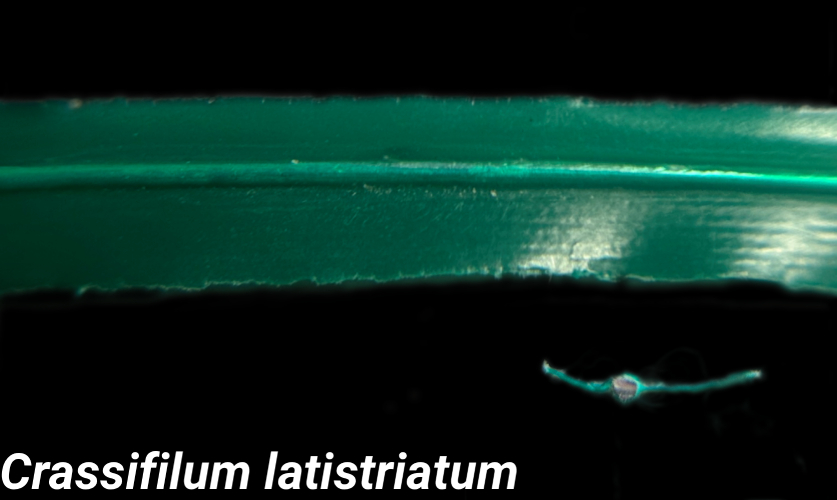
Crassifilum latistriatum Lu, 2025
Width 0.35 cm. Ridge well defined. Margins generally simple. Wings thin, hyaline, lightly striated. Surface smooth.
Ecology/Distribution
Ecology Unknown. USA.
Description
Crassifilum latistriatum is superficially similar to C. striatulus, but differs from the latter by its thinner wings, wider striations, lack of markings on the central ridge, and hyaline appearance.
The epithet “latistriatum” refers to its wide striated markings on the wings.
Type: 20.1 cm long, blue-green. Collected by Bailey Z. Lu (NESRG), in Northern Virginia, USA.
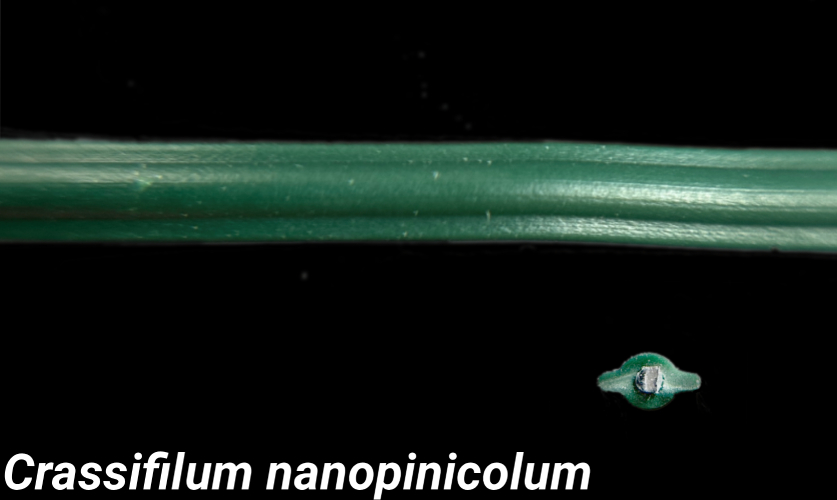
Crassifilum nanopinicolum Lu, 2025
Width 0.2 cm. Ridge both surfaces, well defined. Margins simple. Wings heavily thickened, reduced. Surface smooth, faintly striated.
Ecology/Distribution
Plastic Christmas trees. USA.
Description
Crassifilum nanopinicolum is a well-camoflauged species characterized by its short wings, which are thick and reduced around a large central core. It is often found on the cords of plastic Christmas trees, sharing hosts with Chloronyx pinicola (Chimochaeridae) but displaying resource partitioning.
The epithet “nanopinicolum” refers to its appearance and ecology.
Type: 15 cm long, muddy green. Collected by Bailey Z. Lu (NESRG) from around the cords of a plastic Christmas tree, Northern Virginia, USA.
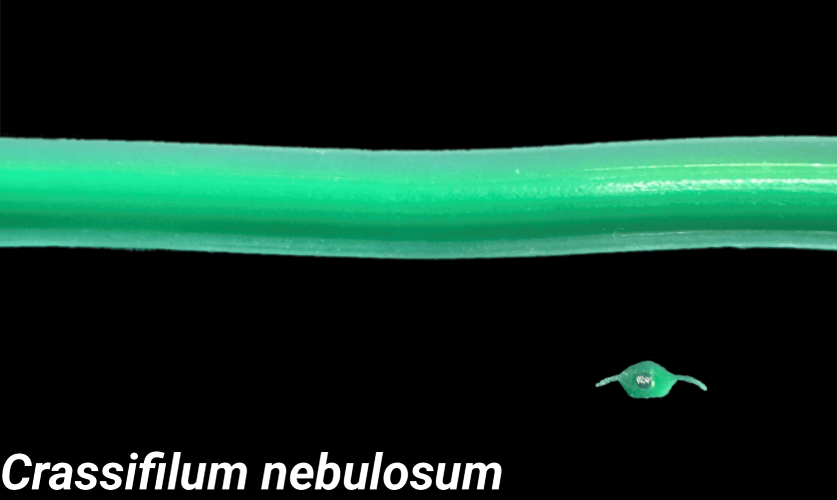
Crassifilum nebulosum Lu, 2026
Width 0.3 cm. Ridge both surfaces, poorly defined. Margins simple. Wings thin, hyaline, weak, reduced. Surface glabrous.
Ecology/Distribution
Unknown. USA.
Description
Crassifilum nebulosum is characterized by its weak, poorly-defined wings. It is superficially similar to Crassifilum cuscutaeformis, but its wings are significantly weaker, thin to the point of being translucent.
The epithet “nebulosum” refers to the misty appearance of its wings.
Type: ~15 cm long, turquoise. Collected by Bailey Z. Lu (NESRG) from a bin in a scrap craft store, Atlanta, Georgia, USA.
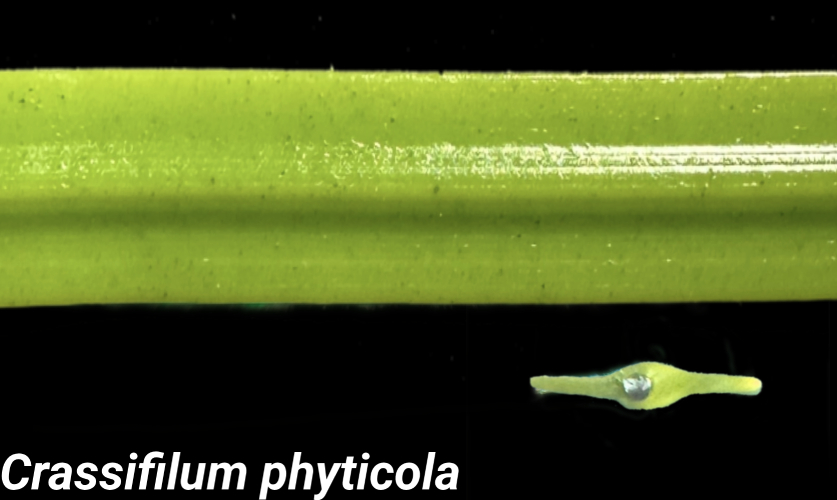
Crassifilum phyticola Lu, 2026
Width 0.35 cm. Ridge both surfaces. Margins simple. Wings thick, poorly defined. Surface glabrous, with small darker speckles.
Ecology/Distribution
Plant stems, gardening sections of stores. Japan.
Description
Crassifilum phyticola can be differentiated from other Crassifilum by its poorly defined but thick wings and width. This species has been observed on many plants in Japan, with tangles of 300 individuals sometimes being found sold in shops.
The epithet “phyticola” refers to this species’s substrate, plants.
Type: Collected and described by Bailey Z. Lu (NESRG) from a tangle purchased from a Daiso franchise, Osaka, Japan.
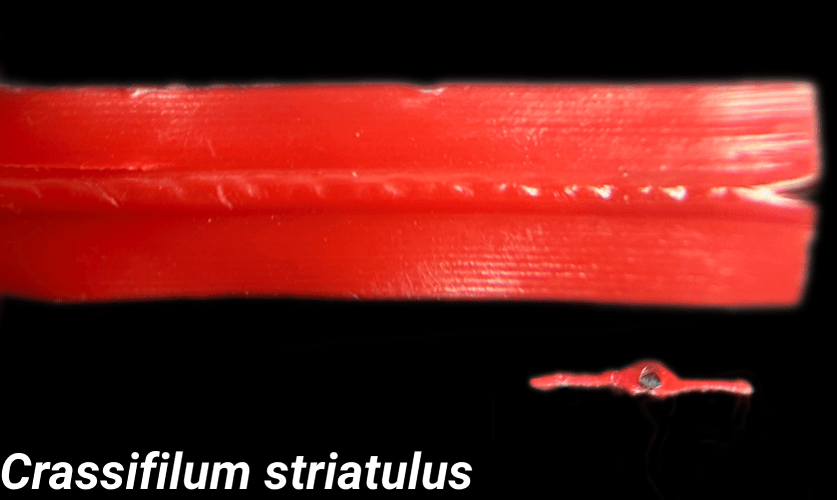
Crassifilum striatulus Lu, 2025
Width 0.4 cm. Ridge both surfaces, with periodical cross-hatched markings on one surface. Margins simple. Wings thick, finely striated. Surface matte.
Ecology/Distribution
Bags of bread. USA.
Description
Crassifilum striatulus is a common tunifilid, characterized by its thick wings, fine striations, and cross-hatched markings on the central ridge.
The epithet “striatulus” refers to the markings on the wings.
Type: 10.3 cm long, red. Collected by Bailey Z. Lu (NESRG) from a bag of bread, Northern Virginia, USA.

